We use cookies to allow secure access to your Herbs For Healing account and to analyse our website traffic. By browsing our website, you consent to our use of cookies
herbsforhealing
Browse, learn, shop and get well. Naturally.
Registered Medical Herbalist
Luzia Barclay
DBTh MIRCH
Tel: 01722 330663
- Main Menu
- Home
- News
- About
- Contact
- Information
- Frequently asked questions
- Herbal Medicine
- Herb Directory
- Newsletters
- Factsheets
- Useful Links
- Consultations
- About Consultations
- Book a Consultation
- Courses
- Course Listings
- Book a Course
- Online Shop
- Herbs & Seeds
- Ground Clay Products
- Bee Products
- Gift Vouchers

Luzia Barclay, of Herbs for Healing has been trading online since 2006. Browse with confidence!
Herbal Directory
 The writer called John Evelyn said in 1664 about Elder:
“If the medicinal properties of its leaves, bark and berries were fully known, I cannot tell what our countryman could ail for which he might not fetch a remedy from every hedge, either for sickness or wounds.”
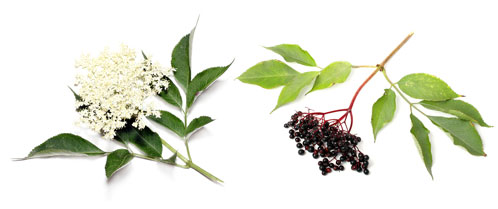
The Elder is a common shrub found in woods, gardens and along river banks.
During late Spring and early summer its clusters of small white flowers emit an intensive scent which is most marked in the evening.
Elder flowers, when infused in hot water (1 or 2 teaspoons per cup) for 10 to 15 minutes are often used to reduce bronchial and upper respiratory catarrh.
They are sweat-inducing, which helps to resolve fever and infection, and they reduce congestion which often accompanies sinusitis and hay fever, without any side effects.
A cold infusion made from the flowers can be used as an eye wash in case of conjunctivitis or as a compress to relieve chilblains.
The infusion can also be used as a gargle in case of tonsillitis and sore throats.
The berries are a mild laxative.
The juice of the berries is very dark and tasty, especially when you add the same amount of hot water and some lemon juice.
Drink one or two cups a day as soon as you feel the first signs of flu coming on, but also of course at any other time in order to prevent a cold or flu.
The berries can be used to make a conserve, but its flavour improves if mixed with apples or plums.
Elder flower juice and wine not only have a long tradition as refreshing drinks, they are part of a ‘spring cure’ which strengthens and stimulates the immune system.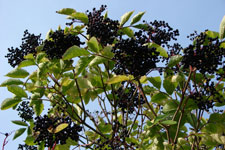
Bring 1 gallon of water to the boil and pour into a clean (sterilised) container.
Add 1½ lb of sugar, stir until dissolved.
When this has cooled down, add the juice and thinly peeled rind of 1 lemon, 2 tablespoons of cider vinegar and 12 elder flower heads.
Cover this mixture with several layers of muslin and leave it for at least 24 hours.
Filter the liquid through the muslin into strong glass bottles.
After two weeks this drink will be ready to serve.
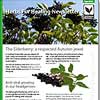

Elder
(Sambucus Nigra)
“If the medicinal properties of its leaves, bark and berries were fully known, I cannot tell what our countryman could ail for which he might not fetch a remedy from every hedge, either for sickness or wounds.”
The Elder is a common shrub found in woods, gardens and along river banks.
During late Spring and early summer its clusters of small white flowers emit an intensive scent which is most marked in the evening.
Elder flowers, when infused in hot water (1 or 2 teaspoons per cup) for 10 to 15 minutes are often used to reduce bronchial and upper respiratory catarrh.
They are sweat-inducing, which helps to resolve fever and infection, and they reduce congestion which often accompanies sinusitis and hay fever, without any side effects.
A cold infusion made from the flowers can be used as an eye wash in case of conjunctivitis or as a compress to relieve chilblains.
The infusion can also be used as a gargle in case of tonsillitis and sore throats.
The berries are a mild laxative.
The juice of the berries is very dark and tasty, especially when you add the same amount of hot water and some lemon juice.
Drink one or two cups a day as soon as you feel the first signs of flu coming on, but also of course at any other time in order to prevent a cold or flu.
The berries can be used to make a conserve, but its flavour improves if mixed with apples or plums.
Elder flower juice and wine not only have a long tradition as refreshing drinks, they are part of a ‘spring cure’ which strengthens and stimulates the immune system.
Elderflower Cordial
A delicious recipe
Bring 1 gallon of water to the boil and pour into a clean (sterilised) container.
Add 1½ lb of sugar, stir until dissolved.
When this has cooled down, add the juice and thinly peeled rind of 1 lemon, 2 tablespoons of cider vinegar and 12 elder flower heads.
Cover this mixture with several layers of muslin and leave it for at least 24 hours.
Filter the liquid through the muslin into strong glass bottles.
After two weeks this drink will be ready to serve.
Elder - September 2010 Newsletter
Herbs For Healing Newsletter - The Elderberry. A powerful Anti-viral growing in our hedgerows. Contains vitamins A, B and C, calcium, iron and potassium, high in flavonoids; natural immune boosting substances to protect against infections and allergies.
Download this newsletter
Factsheets
Find Information Sheets and Top Tips here.
Newsletters